
What if Distress is a Feature, Not a Bug?
Have you ever had an allergic reaction to stress? It's not fun. Last week, after I got some unexpected news that threw my life into upheaval (again), the stress of the situation triggered a histamine reaction. My face—in particular my cheeks and eyelids—completely swelled up and erupted in hives, just like I'd ingested something I was allergic to. Even so, beyond the discomfort and unpleasantness of the experience, there was something objectively fascinating about an overt, physical manifestation of what is normally an invisible experience. If you've ever had anxiety or panic attacks, things that are hard for the less neurotic among us to understand, this might resonate with you. When it's all over your face or body, at least it's no longer "all in your head."
But even if you've never had an acute and visible reaction to stress, you still know that stress is terrible for us. You've learned firsthand how it affects both your body and your brain. This feels more true than ever these days, when everything is so much, so relentlessly. Things have always been bad for someone, somewhere, but lately it feels like everything is bad for everyone, everywhere. There's no escape, literally or figuratively. You can't even watch a cute video of a cute puppy without stumbling into a hornet's nest of antisemitism and racism or comments about animal abuse. And talk about a struggle: I can't even relax by watching tennis because Tennis Channel is owned by Sinclair. Is nothing sacred?
Earlier today, while noodling around to try and work out today's newsletter, I did some internet searches. (Clearly I did not figure the newsletter part out, but thanks for sticking with me as I do it in real time.) I looked up things like "what stress does to the brain" and "what social media does to the brain" and "what doomscrolling does to the brain." I think in some corners of the internet people call this "doing research," so I figured I'd hold constant the variable of the question itself. Science! Anyway, as you might imagine, the responses were things like "stress triggers fight-or-flight, and it can eventually affect mood and decision-making," or "social media and endless scrolling trigger dopamine release which creates addictive loops and can impact emotional regulation."
Then I thought about the feeling we all have online of being overwhelmed, overstimulated, and constantly distracted. The way we all agree our brains were not designed to have this much information thrust at us, to be this available to the people in our lives (and sometimes not in our lives), to be this aware of relentlessness of human and non-human suffering alike. And you know what? We're not. It's right there in the Google search results. Technology and social media shorten our attention spans and make it harder for us to regulate our emotions. Stress puts us into fight-or-flight mode, affects decision making, even causes cognitive impairment. What happens when you get a little peanut butter on my chocolate, or a little chocolate in my peanut butter?
Technology and social media are basically gavage tubes pumping the most stressful shit imaginable into us. Yes, it's possible to carefully, constantly curate our feeds and never look at the comments, but even then you're not safe. So we've got an addictive mechanism that fucks with emotional regulation, which is giving us content that fucks with decision making. And all of this was bad before everyone started getting laid off, and before we had to watch goons ripping families apart on a daily basis while the administration in charge of those goons engages in the worst kind of relentless shitposting imaginable.
None of this is news to any of you, I know. I don't think what I'm saying is groundbreaking. It's hard to break our phone habits. It's hard to stop doomscrolling. But as much as I think tech and culture and humans, for some reason I had never thought about the specifics, what stress does and what technology does and what they do in combination to our brains. Like, no wonder we all feel at a constant breaking point. No wonder people are either disengaging entirely or losing their shit if someone so much as comments awkwardly. No wonder every time I open Bluesky I am convinced 90% of users there have absolutely lost their minds, because why else would people still be posting more than 50 times a day on Christmas or New Year's Eve. The addiction, emotional deregulation, and constant stress responses are destructive enough on their own, but combined? Yikes.
So now I'm thinking about it, and I wonder how—if—it would be possible to design products that unwind some of this behavior. Is this stuff all or nothing? Do we have to brick our phones or buy timed lock boxes and stick our phones in them so we can't access them? This may be surprising to hear—I learned it the hard way—but a timed lock box only works if you use it, not if you just buy it and then let it sit in the box only to return it before your return window is up. As much as I miss my flip phone, I don't want to go back entirely, or go totally analog. Well, maybe I do sometimes, but that's not the world we live in now. I don't have an answer, not yet at least. Certainly not tonight. The stress of the last week has done a number on my brain. But I want to keep thinking and learning about this, about these twin engines of doom, and how they're working together on us.
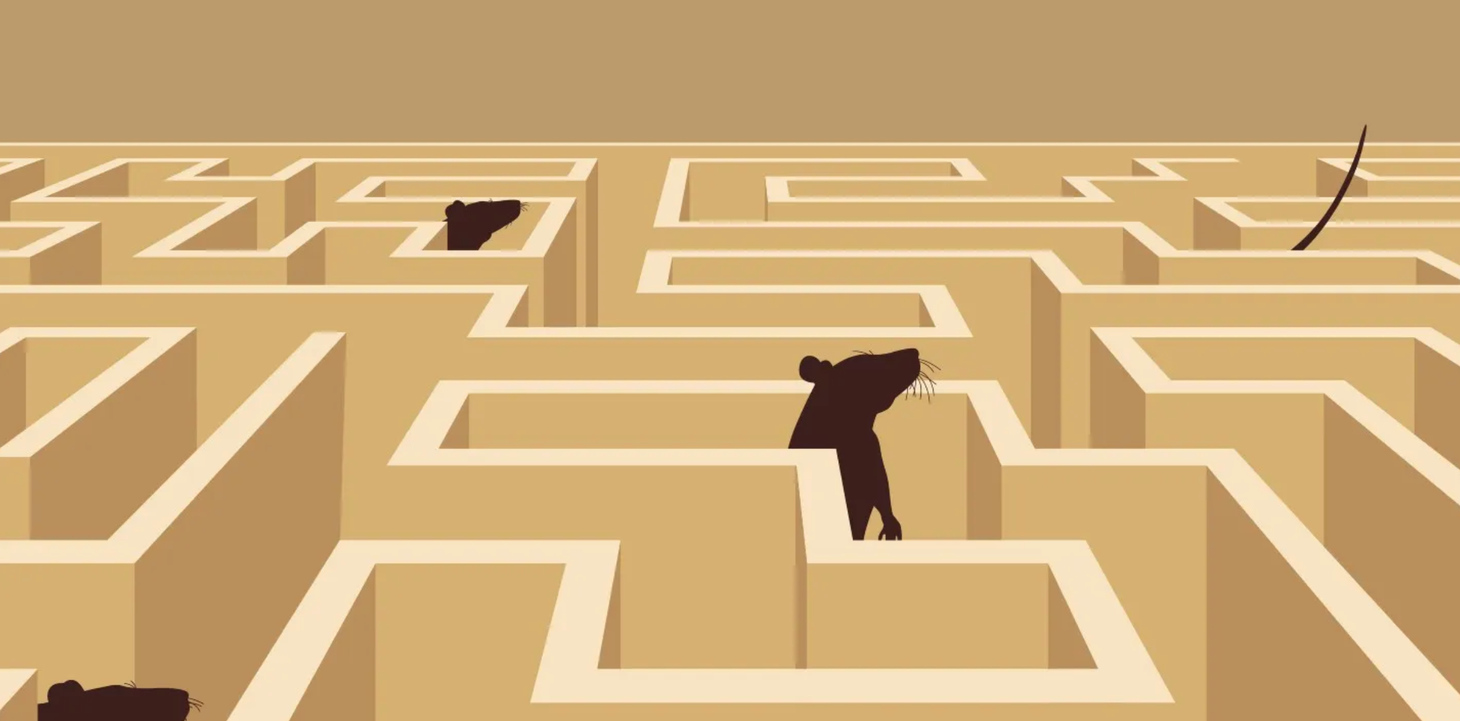
In 7th grade, when it was time to do our science projects, I chose to replicate an experiment conducted by some friends of my parents—two renowned psychologists who studied the brain, and specifically the cognitive processes of learning and memory. My dad and I built a maze, a wooden platform with eight arms of different widths. The wider arms were obviously much more stable, but the narrower the arm got, the less stable it was. At the end of each arm I'd place a sunflower seed. I wanted to know whether a rat or a gerbil was smarter. Which one would learn not only to go to the end of the arm to get the snack, but to identify the arms they'd been down already, which were the easiest and most stable and worth going down first, which were likely to tip over and thus to be avoided?
The rat, named Brad, was of course very smart. He quickly learned the maze, knew which arms to zip down, which to be more careful on, and which to avoid altogether. He also became very affectionate and would sit on the back of my neck under my long hair, his nose peeking out one side and tail out the other. But the gerbil, Janet, never really figured it out. She would go down the same arms repeatedly and would choose the arms haphazardly, often going on unstable arms over and over. She also escaped a lot, which as an 11-year-old I found extremely upsetting and stressful. (To be honest, I would still find it upsetting.) So of course my findings were that Brad was demonstrably smarter than Janet, by every possible rubric. I don't know though. Is it really so dumb to say fuck this, I'm out? Maybe not.
Until next Wednesday!
Lx
Leah Reich | Meets Most Newsletter
Join the newsletter to receive the latest updates in your inbox.