
Take the A Train
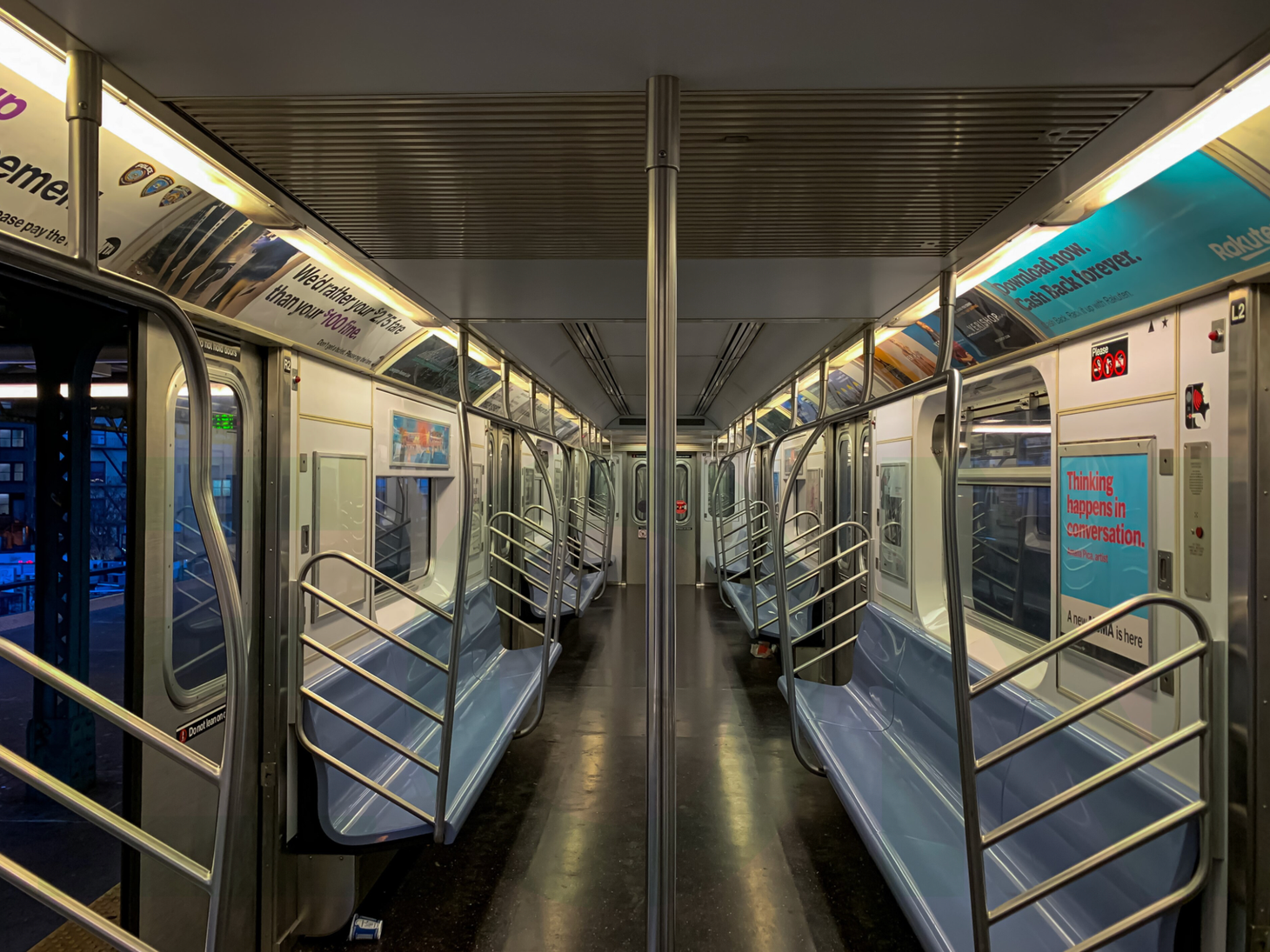
One of my favorite things about the New York City Subway is the way its history is still visible in its present, specifically in terms of its infrastructure. If you've ever ridden the subway, or at least seen photos of it, you know that not all cars are the same size or have the same configuration. Some cars are narrower with seating running along both walls (longitudinal seating), while others are wider, with a mix of seats against the walls and shorter perpendicular benches (transverse or bus-style seating). The narrow cars run on the number lines, known as the A Division, and the wider cars run on the letter lines, or the B Division. There are S, or shuttle lines, for both.
This isn't unique to New York's subway, of course, but I'm not regularly riding the London Underground or the Paris Metro, am I. Anyway, the thing I like so much about its infrastructure isn't the simple fact that different trains and lines have different car sizes and configurations. What I like thinking about is the why.
Like many people, I know the basics of the subway's history. Once upon a time, New York City had elevated railways. Then came the first underground train in 1904. Eventually, various privately owned lines consolidated into two privately owned systems: The Brooklyn Rapid Transit Company (BRT, later Brooklyn–Manhattan Transit Corporation, BMT) and the Interborough Rapid Transit Company (IRT). They were joined by a third, city-owned lined called the Independent Subway System (IND). The city bought and took over the privately run lines in 1940, then in 1953 handed control over to the New York City Transit Authority (NYCTA), which itself was folded into the state-run MTA in 1968. The A Division is made up of the IRT lines, while the B Division consists of the BMT and IND lines.
Please bear with me and do not leave, I swear this is going somewhere. Here's a familiar song to listen to while you read.
The Wikipedia rabbit hole about the New York City Subway system, its history, and its nomenclature is less a rabbit hole than a warren. I guess if I wanted to really beat this metaphor to death, trying to map out the Wikipedia version of the subway's history is like mapping out the subway system itself. For example, take the A Division, or the numbered lines. Before they were the numbered lines, they were just subway lines, built by the IRT starting in 1904. But in 1903, the IRT signed a 999 year (!!!) lease on the four elevated lines operated by the Manhattan Railway Company, lines that were eventually dismantled in favor of the underground lines. So far so good!
But the Manhattan Railway Company — whose president was Jay Gould's son, George — itself leased two other companies, the Metropolitan Elevated Railway and New York Elevated Railroad, which ran three of the four lines. The fourth had been built by the Gilbert Elevated Railway Company, but I still don't know how that line ended up controlled by the Manhattan Railway Company. Then there was a whole thing about fraud via inflated stock market value (sound familiar??). It's a lot, and frankly, I still don't know who owned most of these companies, or how they were founded. It's like I'm in Fulton Station and I'm trying to find the J platform (IYKYK). I do know that the IRT was founded by a (you'll be shocked to hear) financier named August Belmont, Jr. who also founded Belmont Park racetrack. All this and I haven't even started on the BRT, or on the years of naming issues, or on god knows what else. Like the subway, and like this glorious city itself, the whole thing is messy, dirty, fascinating, sometimes awful, exhausting, full of surprises, and the answer to every single question is always money.
Rather like tech, no? I mean, where else can you see history looping back on itself in real time, the decisions of the past affecting the decisions of today? Where else do you see yesterday's quick decisions turn into today's tech debt, or features that took years to build end up being flops? In case you don't click that link, here's the top comment, which makes me laugh every time.

And yet! Unlike tech – yet?? – despite this convoluted and wildly messy history, 120 years the subway is basically fit for purpose. Yes, there are a myriad of issues, but the whole thing is connected now. It still mostly works. And if you want to, you can get from one end of an A Division train to the other end of a B Division train. You could go from 242nd Street in The Bronx to Far Rockaway Beach in Queens without ever having to leave the subway system. I think that's pretty cool.
I love the parallels: Endless layers of products and companies merging into absolute behemoths that control the infrastructure of our lives, then trying to retrofit that infrastructure to our rapidly changing worlds. If you've ever been crammed into a C train on the way to work, or watched a fight break out on the 2, the deep existential dread is a little like the experience of being online. In those moments, it just fucking sucks. Sometimes it's pretty good though, and anyway, it's not like you're going to stop using the thing. But can you imagine people still using Facebook, 120 years in the future? Grim.
Now, you could argue that a subway is more important than a social media network, but in theory aren't they doing similar things? Connecting us to other places, people, opportunities, income streams? And you could absolutely argue that AI is very different from a subway or even from social media. But my point isn't "is AI like a subway." It's the misconceptions we're carrying about how tech, as an industry, works. Beneath the shiny new tools and the endless self mythologizing, there are still many of the same elements and processes.
History, as you may have heard, is useful. The trick here is to remember that while tech companies are talking to their product users in ways railroad companies didn't, they're not actually listening to those product users. Or they're only listening and catering to a specific subset of users, or their financiers, or to whatever competitive bullshit is going on. In other words, they're repeating a lot of the same history: The tangled messes, the stock market valuations, the mustachio-twirling rich dudes, the maybe building stuff because people need it but mostly because it'll make these guys rich and powerful. They've learned from history, but perhaps it's the rest of us who haven't.
Earlier I was reading some of John Hermann's columns about AI and Meta on New York Magazine. I've always found John's work more thoughtful and nuanced than about 90% of tech writing, and these pieces were no exception. I was especially taken with his writing on Aaron Sorkin's new movie The Social Reckoning, a follow-up to 2010's The Social Network. He digs into some of what I've been talking about in my newsletters, albeit from a different and more Hermann-esque angle. Tech companies do not build products, make money, and gain power in an ahistorical vacuum. They are not actually different and special. Much of this is a mirage, one regularly reinforced even by well-intentioned movie makers and whistleblowers. More importantly, they are comprised of thousands of people who build products for billions of people who use them, all of whom can make different choices. He writes:
If a reckoning is due here, it’s with the temptation to accept new industries on their own strange terms, limiting our political imagination about what sorts of problems they’re creating, and how they might be addressed. In 2016, social media reformists talked about guardrails and oversight boards. As AI companies narrate their own arrival, and seek to build companies that they hope will make Meta look small, The Social Reckoning’s layered anachronism works as a warning to everyone outside of these companies to think beyond of the motivated stories tech companies tell about themselves — beyond, say, AI safety or alignment as defined by the labs, and, contra Haugen, in explicitly human terms, even if that means talking about ambition, betrayal, and greed — so as not to get trapped inside them until it’s too late.
(A reminder that while Haugen's leak was hugely valuable, she did it in an unethical way with respect to protecting the individuals who did the research and who had no authority. It's like leaking the names of the local guys who built the railroad rather than just going after Henry Frick for hiring the Pinkertons to shoot them all.)
A few years ago, I listened to a fantastic audiobook about J. Edgar Hoover. It's so good I regularly recommend it to people, despite the fact that it's about J. Edgar Hoover and 36 hours long. It won the Pulitzer, if that sort of thing matters to you. I loved it for a lot of reasons, but one of them is this: I love when someone takes a simple narrative and forces you to complicate it. Here, the narrative is "J. Edgar Hoover was the absolute fucking worst," which is how you go into the book. At the end of the book you still think, "J. Edgar Hoover was the absolute fucking worst," but in a more complicated way. You've spent many hours having to sit with the uncomfortable acknowledgement that he was also a human being. It sucks to think of awful people as actual humans who have feelings and (deep breath) some good traits, who sometimes even do the right thing (although sometimes for the wrong reasons). More importantly, you've spent many hours being reminded that awful people do not gain power in a vacuum. They alone can't build, sell, and reinforce a myth that they're doing good for you while actually benefitting themselves. That requires the support of a vast machine made up both of the bad guys and, unfortunately, a decent chunk of the good guys. At some point we have to start seeing this while it's happening, not after.
The question, of course, is the question I always ask. John Hermann even says it directly. When are we going to stop talking about the tech, and start talking in human terms about the humans?
Until next Wednesday?
Lx
Leah Reich | Meets Most Newsletter
Join the newsletter to receive the latest updates in your inbox.