
I Don't Think These People Would Taste Good
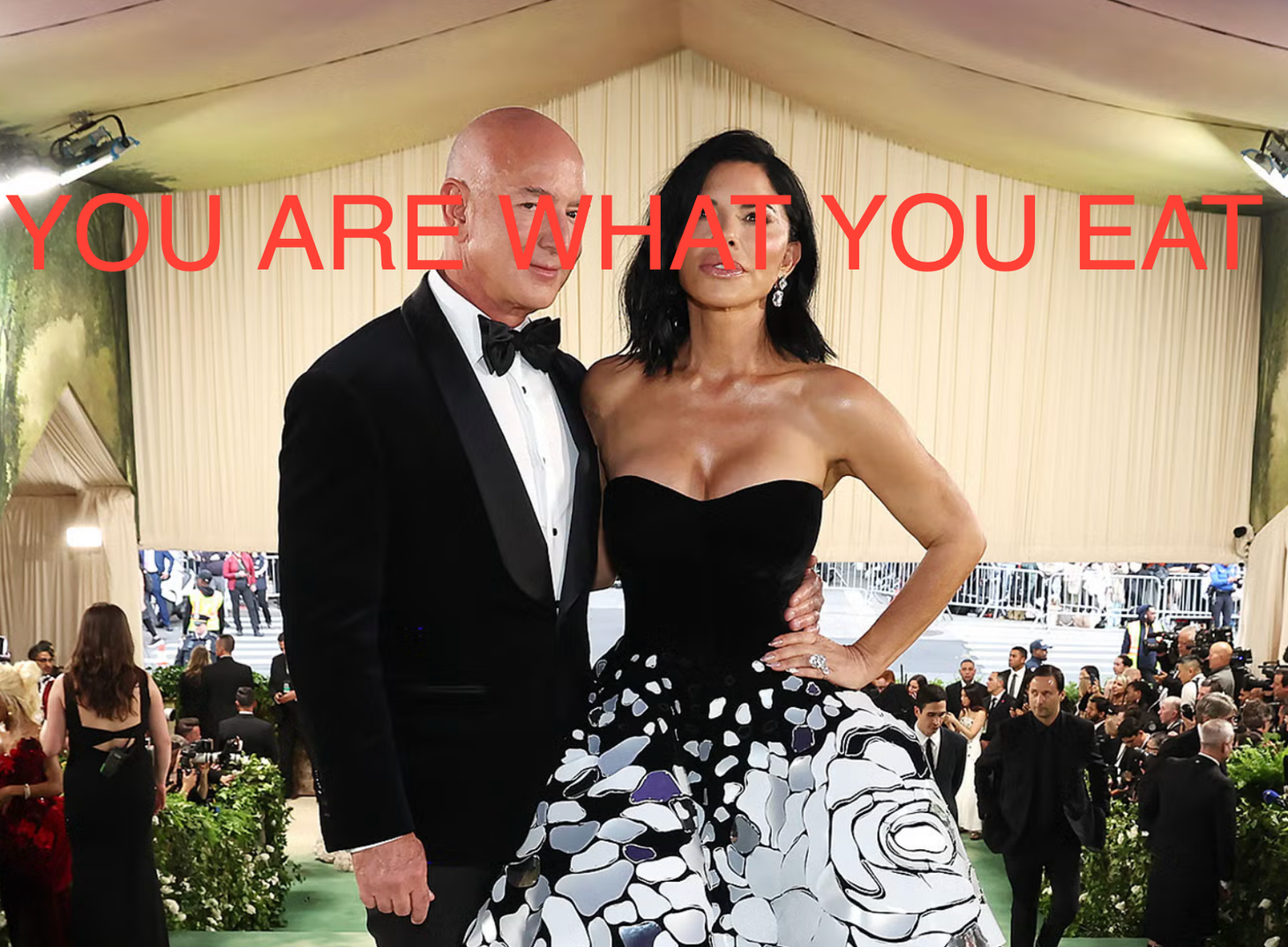
Earlier this week, I remembered that I currently set my own work schedule, so I took Monday off. First I had lunch with a dear friend at a beloved establishment that's sadly closing, and then I meandered over to The Frick to see a fantastic exhibit before it, too, ends. It was a stunning day, a much-needed, perfectly sunny, breezy, not humid mid-70s kind of a day that we've had too few of this spring. I leisurely walked up 5th Avenue from East 70th Street toward a doctor's appointment in the upper 90s. But within a few minutes, I saw a blockade of sidewalk barriers and large black cars, plus police officers and people gathered around waiting and watching.
Meets Most is a reader-supported newsletter (no ads, no affiliate links). If you enjoy it, you can become a paid subscriber. Your support means a lot! Thanks for being here.
"What is this?" I asked a woman, a tourist. "The Met Gala," she responded.
Oh, right. I should have known. I live close enough to the Met that I can walk there in under 20 minutes, and I am frequently online. But my day had been so offline that I'd completely forgotten about it. Maybe I should try that more often.
Have you read this Slate piece about the Met Gala? It encapsulates a prevailing sentiment about the event, and about this Met Gala in particular: It used to be pretty cool, at least for people who love fashion, but then it became crass and commercial, and now it's truly terrible because all the worst people in the world showed up.
Look, I get it. I too want to see as little of Jeff Bezos as possible. I too find it absurd that someone from OpenAI is on any red carpet. I too am angry at tech, and at the tech giants in particular. All of our anger and outrage is maxed out, and for many good reasons. But guys, can we be real for a minute? In fact, let's be real in a few ways.
Tech companies have been the lead sponsor of the Met Gala multiple times since at least 2012 when—are you ready for this?—Amazon was the lead sponsor and Bezos was an honorary co-chair. After that, other tech companies followed suit, including Yahoo! (remember Marissa Mayer, anyone?) and TikTok. In 2016, it was Apple's turn, when the theme was (drumroll please) "Manus x Machina: Fashion in an Age of Technology." And of course, Instagram was the lead sponsor in both 2021 and 2022, with Adam Mosseri as co-chair and Eva Chen heavily involved across the board. Maybe we were too busy being distracted by AOC's dress in 2021, or by Kim Kardashian's unfortunate Marilyn Monroe gown stunt in 2022?
Yes, I know that 2026 is the first time two tech people have been the lead sponsors, not a tech company. I guess that makes a difference? Or is the difference really that the past year and a half have been so shit on so many levels that now we're finally like, you know what, get tech the fuck out of... this event whose entire raison d'être has always been to raise money for the Costume Institute? This event that has kind of always been about absurd wealth and unattainable levels of celebrity, in addition to cool fashion?
Because frankly, I found it pretty gross to watch Mosseri co-chair, in the midst of the Instagram Papers leak, with the lack of accountability the company took during that time, plus the fact that six months later they started laying off 21,000 people. But that's just me!
There are two extremely divergent but equally absurd ideas people have of the Met Gala itself, and the role wealth should or shouldn't play. First, you've got everyone who thinks the Met Gala is a dystopian display of wealth. The "Hunger Games" of fashion if you will. Luckily, one of my favorite thinkers/writers already broke down this line of thinking in a very smart way. Derek Guy, take it away:
Pierre Bourdieu once argued that the question of whether something is art isn't answered by the artist's intention or even the object itself. Instead, the quality of being "art" is conferred by a community — curators, dealers, auction houses, audiences, etc. 🧵
— derek guy (@dieworkwear.bsky.social) May 5, 2026 at 6:58 PM
[image or embed]
Please read his entire thread! I won't even be mad if you stay on his thread and forget to come back here! He notes that many institutions conduct fundraisers with wealthy private donors. This one's just a) a notable public event and b) about fashion, which can easily be dismissed as "silly," "frivolous," and "not art," even though none of that is true. Side note: I really wanted to study the sociology of fashion when I was doing my PhD, but I didn't have the guts (silly story for another time). Hence my deep admiration for Mr. Guy.
A big question I have is this: Does anyone know where the Metropolitan Museum of Art itself came from? Does anyone know where most of our country's revered institutions came from? Has anyone, you know, read any history? Not even read! Watched! I thought all of you loved the Gilded Age!
There are a lot of fun quotes in this Slate piece, but let me throw this one in:
The ease with which these two tasteless oligarchs purchased a position of honor at one of fashion’s biggest events, held to benefit one of the world’s finest art institutions, exposes the hollow core of greed at the center of two industries purportedly concerned with creative excellence.
As much as we all hate the timeline we're in, and as nostalgic as we all are for a more refined version of the past, can we please remember: The cofounders of the Met included financiers and businessmen. They were the sons of shipping barons, inheritors of vast fortunes who then went on to make even vaster fortunes as railroad tycoons and major industrialists. They were the 19th century equivalent of today's billionaires.
Sure, you say, but those 19th Century guys were real philanthropists. They had ideals! They cared about bringing art and education to the masses! The Met was imagined as an institution for working men! Jeff and Lauren are literal monsters who only care about being popular and making money! Have you seen what happens to Amazon warehouse workers? Again, I beg of you, read a book, or even this Wikipedia article about the Homestead Strike, which involved two ruthless industrialists slash extremely notable philanthropists, Andrew Carnegie and Henry Clay Frick. You had to be just as much of a sociopathic asshole to become a robber baron then as you do now.
Don't get me wrong—I'm not excusing Mr. and Mrs. Bezos (does anyone know what the plural of Bezos is?). I don't want Mark Zuckerberg anywhere, anymore, period, let alone at events like this. I was even weirded out (for many reasons) to see my old boss on the red carpet, although I do appreciate the gift he and his wife made to the Met. (Note to other billionaires: Wouldn't it also be nice if the regular staff made money, and not just the interns? See below.)
But y'all, this is how the world works. This is how the world has worked for centuries. You thought Bertha Russell was just a fun story? Alva Vanderbilt was considered by some in her time to be a gauche nouveau riche woman. She literally bought her way into society with the money her husband inherited and earned, spent enormous sums of money to do so, and was an awful mother in the process. On the plus side, she built the Metropolitan Opera and later became a very powerful suffragist who financed a lot of the movement. So again: Many of these people were the 19th Century's billionaire equivalents! Literal monsters who also created beloved cultural institutions and ended up doing some good for society!
Dammit, I've been ranting for 1500 words and I haven't even gotten to what's most important to me. I buried my own lede and probably lost most of you before I even get here! The bit that really struck me in the Slate article was this:
This wasn’t just another charity ball, another way for rich people to luxuriate in finery under the pretense of supporting an arts nonprofit. It was a gathering of artists and muses, a celebration of people who make things that make us feel things.
Not this year. This year, the Met Gala bowed down to tech titans. Executives from OpenAI, Instagram, Snapchat, and Amazon walked the carpet. Mark Zuckerberg attended for the first time. These are people who make things that make us addicted, poor, depressed, starved of real human connection, and alienated from the world around us—in other words, the opposite of art.
Okay, so here's the thing, and I don't think you're going to like this very much:
Remember a while back when I wrote this, about what we value, celebrate, and reward becomes part of our culture? It's very aligned with what Derek Guy wrote in his thread, which is another reason I love that thread so much. Much the same has happened here, both with the Met Gala and with the products we hate so much. Why was it sort of ok that Instagram funded the Met Gala? Was it because Instagram was still cool-ish? Because we weren't furious at tech yet? Because tech hadn't thrown in its lot with Trump, forced AI on us all, and decimated the job market? Lauren Sanchez-Bezos is the natural endpoint of everything we slowly normalized before her.
But more than that, the point about the products these people make, that we hate, but somehow keep using. Because of course, even if you boycott Amazon, even if you quit Meta, is that enough? What about Substack? What about X? What about so many other brands and products, tech and otherwise, that I honestly lose track?
Here is an unfortunate truth about people that I've learned in my years as a user researcher: The only thing that will truly get them (you) to switch to a new product is a better experience. You can ask anyone who has ever worked on or built something in tech, and they will say the same thing. People will try to switch for ideological reasons, or they'll quit for a while, but if the experience isn't better, they'll go back. Like someone who quits social media and likes the peace it gives them but also finds themselves totally disconnected from friends and events, since social media provides so much infrastructure to our lives. Or someone who wants to try another browser that's a little clunky, or a newsletter that doesn't have social features (hello), or a decentralized social media platform that isn't quite as slick and full of cool content as the big platforms we're familiar with.
It's hard to remember what we trade for ease of use, for more of the content we like, and for a better experience. The problem, of course, is how we've come to define a "better" experience. Better are the things the fancy apps do well and are immediately apparent: Great design, no lag, intuitive, no work on your part to curate a timeline or connect to friends. We want to think we're better than that, but in practice, we aren't. I've done the research. Which, again, is why the uproar over the Met Gala and all these tech assholes makes me laugh. Why are you still watching it? You can switch to something else!
You want things to be better? Then we all—individually and collectively—have to redefine what better means for us. Better has to start being the things that are less obvious and immediate.
Until next Wednesday!
Lx
Leah Reich | Meets Most Newsletter
Join the newsletter to receive the latest updates in your inbox.