
Amplification, Acceleration, Aggravation: How Social Media Rips Us Apart
Remember the days when there was nothing more boring than listening to someone else describe their dreams or, worse, a drug trip? We were so young and innocent then. Now we have to listen to people try and explain a meme or drama on the internet.
Last week there was a big kerfuffle over an article that appeared in New York Magazine. There were 60 different people in 60 different jobs, and the main question was "how much do you make?" Specifically, the kerfuffle was over this (anonymous) person and how much they made through their fashion newsletter on Substack.
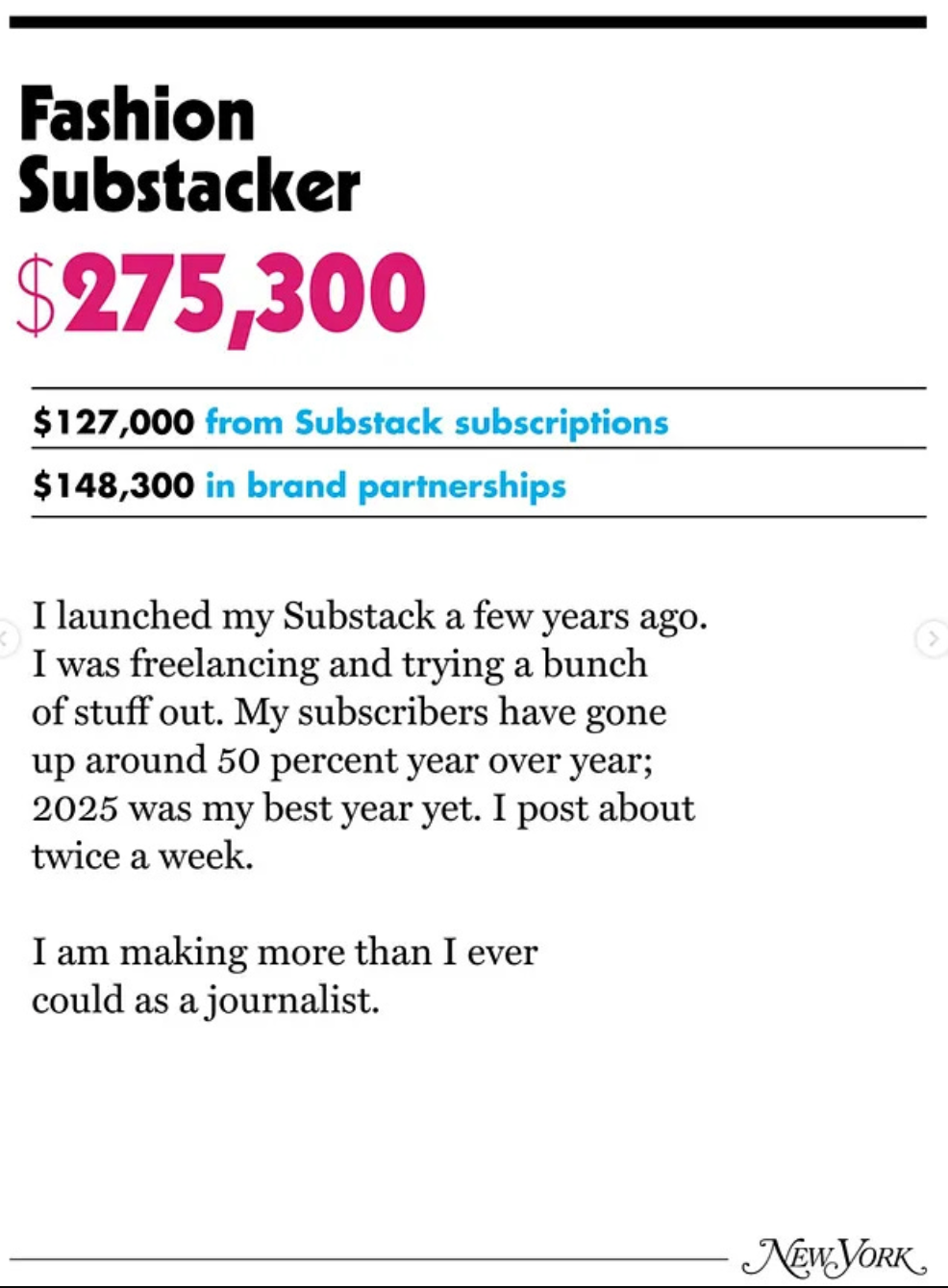
The whole thing unfolded primarily on Substack, as you might imagine, but it made waves elsewhere too. Much of the discussion and many of the arguments focused on the how of it all—how does someone make money doing this, how does someone make this much money doing this, how come I am not making money doing this, and so on. As I cannot explain anything about affiliate links, ads, or sponcon (sponsored content), I will direct you to an expert on such things (and yes, I know the link is paywalled). As the "how" discussion continued, it began to morph. Is this a good way to make money? Is it ethical? How do influencers feel about it? How do consumers feel about it? This, of course, led to questions like: Is it misogynist to question this model of earning? Is it anti-feminist?
There is so much I could say about all of this. I've said some of it already, in Substack's "Notes" feature, which is the equivalent of an in-app X/Twitter or Facebook newsfeed. But I don't want to wade back into the main argument so much as I want to use it as an example to talk about how and why arguments like it spin up and metastasize so quickly on the internet, then spill over into offline life. Call me crazy, but I view it as a smaller, much less virulent version of the terrifying online/offline behavior in the aftermath of the October 7 attacks. But don't call me too crazy, because I'm certainly not about to wade into that argument in this newsletter.
When the New York Magazine article first landed, what most people wanted to know was "Who??" Who was this anonymous Substack fashion person? A lot of the people who wanted to know were people who already have fashion- or other-related Substack newsletters, or they were people wondering if they should launch one and get in on the gig. So the question of "who" was, in a lot of ways, more than the usual curiosity. It was about comparison.
The immediate, and almost universal assumption, was that it was a she. (A name and/or identifying characteristics have yet to be revealed, by the way.) After all, many fashion newsletters, blogs, and social media accounts are run by women, and women's fashion historically has brought in more money than men's. So it was no surprise that the vast majority of the comments and conversations I saw not only carried this "who is she," assumption, but were from and between women on Substack. Plus, women continue to earn at least 15% less than men do even while doing the same jobs, and high-earning women are still less comfortable sharing how much they earn. Of course a lot of women would immediately want to talk about this. It was a real pressure release moment: "Wait, one of us is earning that much (or more) on this thing we're all doing?"
But then, of course, it became clear that 1. not everyone is earning that much and 2. not everyone is doing this thing. And that's where the lines began to form.
On Substack, as with all social media platforms—and Substack is a social media platform, no matter what anyone argues otherwise—there are multiple ways you can be an end user. You can be on there to write a newsletter, you can be on there to read newsletters, you can comment or post a Note, you can hang out in the chat connected to and thus owned by each newsletter. You can use the networked nature of Substack to boost your own visibility by commenting everywhere and on everything, or you can just leave comments because you like having conversations with writers. You can do all of the above, and you can also do only one of the above.
Also on Substack, as with all social media platforms, I assume that the vast majority of content consumption is produced by a relatively smaller number of creators. Maybe it's not as extreme as, say, on Instagram, but Substack is still a young platform, and people are still bought in to the idea of it as a place to write, read, and connect with others—just as they were bought in to the idea of Instagram as a place to post photos, look at photos, and connect with others. So there are probably a decent number writers churning out newsletters, the way we used to share our photos to our Instagram Feed, before the Feed got taken over entirely by brands and influencers.
Of course, as Substack has grown, so too have brands taken note, they way they always do. There are the familiar affiliate links, where the writer (or influencer) links to something you can buy, and if you click on that link and buy the thing, they get some money. How much money they get depends on the brand as well the deal they have with the brand. There are discount codes, gifts, hosted trips, all sorts of payments for mentioning products, and so on. (Read the piece I mentioned above, even if you have to pay for it. She breaks it down.) But not everyone discloses what is or isn't an ad, what's sponcon and what isn't, what was discounted or a gift or a hosted hotel stay, so a lot of the time you have no idea. You just think, wow, how on earth does this person afford all these trips to all these insane resorts, and also all these expensive things? Legally they have to disclose but the requirements are much stricter in the UK and EU than the US, and also: Who is monitoring any of this? (Again, go read my friend who will eventually explain disclosures, too.)
Maybe you knew about some of this stuff, but didn't know how it worked. I definitely didn't have a full understanding of it, because I am merely a consumer being marketed to relentlessly. So after everyone asked "who is she and how is she doing this," my friend broke it down for those of us too dumb to monetize what we do here. That's when the lid blew off.
I'll divide the camps into roughly two groups: People who thought the entire affiliate marketing system was kind of gross, and people who did not. The "gross" camp was mostly people who didn't make money through affiliate marketing, although some did and some used to. To be fair, plenty of them said, "Okay, maybe it's gross, but so is my shitty day job." And even if they thought affiliate marketing was gross, they still very much understood why it exists and why people would use it. Most of them did, in fact! They wanted people to get paid for their work. They just didn't love that this is the apex of human potential. They didn't love being marketed to all the time, in every situation, even when they're not aware of it. They also asked questions like: The more marketing seeps in, the harder it becomes to trust the person who writes the newsletter, so do you like this thing, or were you paid to like it?
The "not gross" camp was mostly made up of affiliate link users and their supporters. This camp perceived the breakdown of "how affiliate marketing works" as a direct attack on them. They said the breakdown was pointless because everyone knows how affiliate marketing works, right? (Not everyone knows what you know!) Their reaction was, as you might imagine, more personal and more defensive. They saw everyone going "wow wait, this system sounds kind of gross." To them, the people benefiting from that system, it must have sounded like "wow wait, YOU are kind of gross."
One of the interesting things about the evolution of the internet, and especially about the rise of social media is how it's transformed not only our relationships with each other as well as our relationships with marketing and commerce. All of it overlaps now. While advertising has been omnipresent in the US for as long as any of us can remember, it hasn't been this omnipresent. There were spaces and experiences, both offline and online, where you could reliably expect no ads, no marketing, no one watching what brands you talk about or collecting your data. Those spaces seem to contract a little more every year. This gives people more opportunities to make money, but it also gives us less opportunity to talk about the stuff we like without feeling constantly monitored or marketed to. It gets tiring feeling like a cash cow at every turn. We're all at the ends of our respective ropes.
Another interesting thing about social media is how it was absolutely not designed for any form of nuance. Or, frankly, any form of real actual human communication. Let's look at the two camps above again, Gross and Not Gross:
- Camp Gross is mostly criticizing the system, maybe a little criticizing the individuals, while
- Camp Not Gross is mostly defending the individuals, and thus a little bit defending the system
Neither camp is really talking to each other, they're just talking at or past each other. There are no mechanisms on social media that allow for two people to stop, look at each other, take a breath, de-escalate, and try to actually hear one another. The yelling just gets louder, more people jump in the fray, and positions start to calcify.
Because on social media, the opposite mechanisms are in place. Social media, by design, does three things: it amplifies, it accelerates, and it aggravates (or makes something more aggressive). Think about going viral, which can be overwhelming and terrible. Think also about the reverse, about feeling isolated and alone while everyone you see in your little handheld portal is out living their best lives, being hot and cool and successful.
This is my triple A-theory of social media: Amplification, Acceleration, Aggravation.
Once these mechanisms are engaged, there's nothing we can do to stop them. Each side feels misunderstood, misrepresented, angrier, more defensive. People dig in, getting more tribal, opinions and beliefs becoming more extreme in direct opposition to the extreme beliefs being pushed from the other side. In this whole affiliate marketing argument, Camp Not Gross began accusing Camp Gross of being misogynistic for questioning the entire affiliate system, and for asking: Is this the best way for us to make money? They asked, "Why aren't we up in arms about the PR person or the podcaster in the article? If this were a man would we be mad? Why are we focusing on the Substack newsletter?" (Spoiler: Because you were on Substack.) Camp Gross was like, how dare you call us misogynistic, this place sucks, we're out of here.
One of the stupidest things we ever did—and frankly still do—is claim that "online isn't real." Yes it is. Don't our brains perceive it as real? Don't we take offline behaviors online, and vice versa? Hasn't so much of internet culture crept into offline existence? If you want to know why we're all at each other's throats more than ever, look at these mechanisms. Look at how quickly we can go from asking a question only to being yelled by a huge group of people that seems to swell out of nowhere and get continuously more aggressive. Look at how much of that feeling and behavior we hold onto when we put our phones down, shut our laptops.
But let's go back and take a closer look at the arguments themselves. Where did the accusations of misogyny come from? There's no explicit mention of gender in the explanation of affiliate marketing. There's just a general assumption from readers that it must be a woman, along with the defensiveness from other women about how they're making money. Someone maybe mentions misogyny, or says they feel uncomfortable because so many women are influencers and asks why we're so much harder on women's endeavors than on men's. Maybe no one's accusing anyone at first, just like no one was criticizing anyone at first. But mentions and feelings and bits of conversation are being picked up by algorithms and misread by other users in an endless game of Telephone. And what happens when a live grenade gets tossed into an already heated online discourse? Kablooey. Now there's misogyny all over the walls.
Let's also take a look at the structure of Substack itself. In many ways, Substack is sort of the final form of social media, the ultimate walled garden. There's long-form writing, short-form writing, video, audio, photos, chat groups, direct message, comments. You name it, it's in there. This means you can take advantage of the incredible network effects to make your voice heard and to connect with wonderful, likeminded people. People really rallied to both camps! Unfortunately, you also have to experience the downsides of being trapped inside that walled garden with all the other people, as they engage in the uglier types of human behavior like talking shit, being passive aggressive, subtweeting, not having direct conversations. At the end you sort of feel like you can only defend yourself in the worst format of all: An open letter. And unlike in offline life, inside that walled garden you have to see almost all of it as it happens around you. There's no escape.
This is our modern deal with the devil, really. We want the opportunities these platforms afford us, but we forget to consider the downsides. Yes, people are making money and getting more visibility, but there's also a cost to those mechanisms. Lately, more and more, I feel like the cost is our humanity.
Until next Wednesday.
Lx
Leah Reich | Meets Most Newsletter
Join the newsletter to receive the latest updates in your inbox.